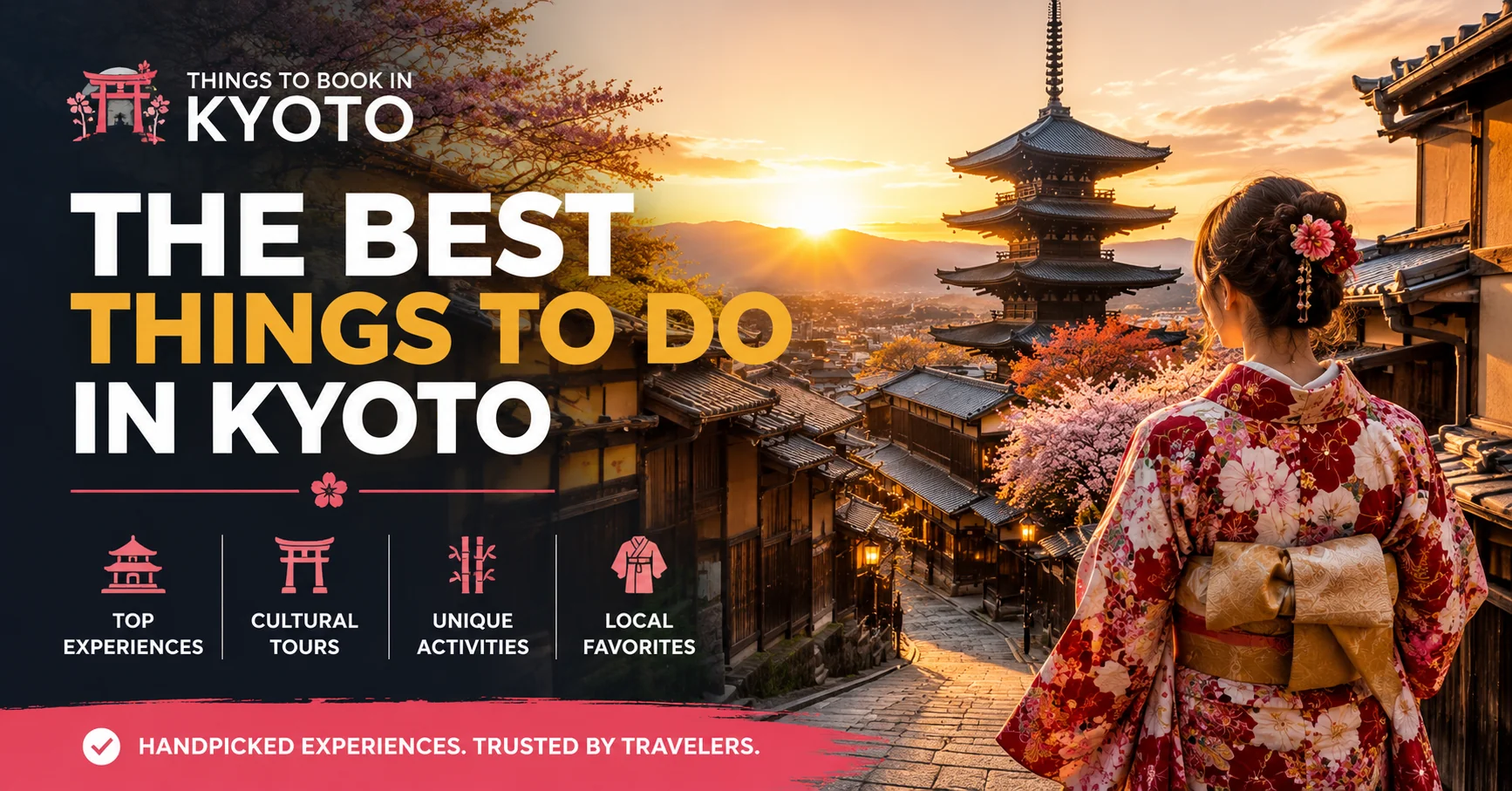
Kyoto · Japan · 119 Tours Compared
Things to Book in Kyoto — Your Decision Guide
What to book in Kyoto — tea ceremony, geisha tour, kimono rental, Fushimi Inari, Arashiyama, day trips, and private tours. Expert decision guide.
Which Kyoto Experience Is Right for You?
Choose the Right Kyoto Tour
Kyoto offers seventeen fundamentally different visitor experiences — cultural, culinary, spiritual, and excursion-based. Here's how to choose.
Whisk Matcha in a Kimono
Book the classic Kyoto pairing — dress in a kimono, then sit for a traditional matcha ceremony in a Gion or Kiyomizu tea house, guided in English. From a quick budget sitting to a kimono-and-photoshoot package.
Browse Kimono Tea Ceremonies →Gion Corner Show
Seven classical arts in one hour, maiko included — the honest ticket advice (buy at the door) and the evening walk that makes it land.
Plan the evening →Sit Zazen with a Monk — Don't Just Photograph the Garden
Book if you want to practise Zen, not just view it. A monk-led zazen session in a quiet temple — posture and breathing taught from scratch, time to sit in real silence, then tea and a talk with the monk. English-guided, no experience needed.
Browse Zen Sessions →Walk Kyoto's Lantern-Lit Geisha District
Book if it's your first night in Kyoto. 90-minute walking tours through Gion's preserved machiya streets — Hanamikoji, Shirakawa canal, wooden teahouses, and the small chance of glimpsing a maiko walking between engagements. Different from the sit-down Geisha Experience card.
Browse Gion Walks →Kyoto After Dark — Ghost Stories & the Night Bamboo Forest
Book if you've done the daytime sights and want Kyoto's other side. A small-group night walk into the Arashiyama bamboo forest after the crowds leave — researched ghost stories, yokai folklore, dark history, and a brief solo walk in the dark. Two longer alternatives cover cursed history and a half-day spirit-realm trek.
Browse Ghost Tours →Real Maiko, Not the Tourist Trap
Book if you want to actually meet a maiko — not just glimpse one in the street. 60–90 min private seated experience: she performs a traditional dance, pours tea, and answers your questions through an interpreter. The closest most tourists will ever come to a real ozashiki.
Browse Geisha Experiences →Dress the Part for a Day in Kyoto
Book if you want the photos — and the experience of walking the stone streets of Gion or Higashiyama in a kimono. Most rentals include hairstyling, accessories, and 5–8 hours to explore. Perfect to combine with a tea ceremony or shrine visit.
Browse Kimono Rentals →10,000 Torii Gates, Before the Crowds
Book if Instagram's Fushimi Inari photos sold you on Kyoto. The shrine is free — the tour is worth it because it gets you there at sunrise when the tunnels are quiet, with a guide who explains fox-spirit mythology and shrine etiquette.
Browse Fushimi Inari Tours →The Bamboo Grove Plus Monkeys, Temples & Matcha
Book if you want the iconic Kyoto day-out. Arashiyama's bamboo grove, Tenryu-ji temple, Togetsukyo Bridge, and the Iwatayama monkey park — usually bundled with an e-bike tour or small-group guide so you don't lose 2 hours commuting.
Browse Arashiyama Tours →Paddle the Hozugawa Rapids to Arashiyama
Book if you want Kyoto's active side. Grade 2–3 white-water rapids down the Hozu gorge from Kameoka to Arashiyama — gear and an English guide included, beginner- and family-friendly. Prefer to stay dry? The scenic Sagano train + Hozugawa boat cruise runs the same gorge.
Browse Rafting →Soak in a Mountain Onsen — and the Tattoo Rules
Book if you want to escape the temple crowds. Kyoto isn't a hot-spring town, but the mountains north at Kurama have a natural onsen — this guided half-day hikes the cedar forest to an open-air bath. Plus the full picture: tattoo rules, private & day-use baths, and etiquette.
Browse Hot Springs →Ride a 600HP Nissan Skyline GT-R (Fast & Furious Style)
Book if you'd rather ride "Godzilla" than visit another temple. A passenger ride in a tuned ~600HP Nissan Skyline GT-R — the JDM and Fast & Furious icon — past Yasaka Shrine and through a high-speed tunnel. You ride, a pro drives. A bucket-list hour for car fans.
Browse the GT-R Ride →Kyoto's Hardest Ticket — How to Actually Get In
Opened 2024 in Uji, the Nintendo Museum is reservation-only and heavily oversubscribed. This is the guide to the official lottery vs. a date-specific reseller ticket, prices, hours, getting there, and what's inside.
Browse Nintendo Museum →Forge a Japanese Knife You'll Use for Years
Book if you want a souvenir you'll actually use. Forge a real high-carbon knife at a working Kyoto blacksmith — or branch into forging a ninja shuriken or learning samurai swordsmanship. Hot, hands-on, and yours to keep.
Browse Knife Making →Mend Broken Pottery with Gold
Book if broken-and-mended-in-gold speaks to you. Learn kintsugi — Japan's art of repairing pottery with gold — and take home the piece you mend. Three workshops compared, from a $9 budget session to the most-booked central class.
Browse Kintsugi Classes →Learn Shodo with Brush & Ink in a Machiya
Book if you want a quiet, hands-on hour. Learn shodo with brush and ink in a 150-year-old machiya and brush your own kanji to keep — or fold it into a private tea-and-kimono cultural day.
Browse Calligraphy Classes →Play Japanese Drums in Gion
Book if you need to blow off the temple calm. Play full-size Japanese taiko in Gion — loud, physical, and great for kids — or sit back and watch a high-energy live drum show instead.
Browse Taiko Drumming →Shoot a Traditional Japanese Bow
Book if you want "standing Zen," not a sport. Draw a two-metre Japanese yumi and loose real arrows under an instructor in a Kyoto dojo — kyudo is about form and breath more than the target.
Browse Archery / Kyudo →Free-Roaming Deer & Todai-ji's Giant Buddha
Book if you have a full day to spare. Nara Park is 45 minutes from Kyoto — 1,200 bowing deer, the Great Buddha Hall, and Kasuga Taisha shrine. Most tours combine it with Fushimi Inari or Arashiyama for one packed day.
Browse Nara Day Trips →Swing a Katana, Throw a Shuriken
Book if you're travelling with kids or want a hands-on afternoon. Dress in a samurai uniform, learn kendo kata from a licensed teacher, or tour the Samurai & Ninja Museum. Budget options from $21; premium full-uniform classes run $100+.
Browse Samurai Experiences →Live Wrestlers + Chanko Hot Pot — Kyoto's Bookable Sumo Experience
Book if you want to see sumo but the 6 annual tournaments are all elsewhere (Tokyo, Osaka, Nagoya, Fukuoka). This 90-min Kyoto show has retired pro wrestlers demonstrating bouts, serves the authentic chanko nabe stew wrestlers eat, and ends with a photo in the ring. Daily bookings year-round.
Browse Sumo Shows →Non-Verbal Theatre Show — No Language Barrier, Heritage Venue
Book if you want a sophisticated Kyoto night out without needing Japanese. GEAR is a 90-minute wordless show fusing mime, breakdance, magic, and laser/light effects — staged in a 100-year-old heritage theatre near Sanjo. Award-winning, family-friendly, daily evening shows.
Browse GEAR Tickets →Inside Fushimi's 400-Year-Old Breweries
Book if you care about what Japan actually drinks. Fushimi is Japan's second-biggest sake-brewing district — tours include 5–7 sake tastings, a brewery walk, and food pairings. Izakaya crawls available for a louder evening.
Browse Sake Tours →Your Own Guide, Your Own Pace
Book if you're 2–6 people, budget allows, or you want to skip the bus tour script. Licensed national guides, customisable itinerary, and a vehicle option for $300+. Fastest way to see 4–5 UNESCO sites in one day without exhausting yourself.
Browse Private Tours →Imperial Palace + Nijo Castle — Two UNESCO Sites on Foot
Book if you want UNESCO depth without a bus tour. A 3-hour central-Kyoto walk covering the Imperial Palace (1,000 years of emperors) and Nijo Castle (1867 handover of shogun power to the emperor). Flat ground, licensed English guide, Nijo admission included. 4–5 km total.
Browse Walking Tours →Nishiki Market, Pontocho, and Kaiseki Tastings
Book if you want to eat Kyoto, not sightsee it. Nishiki Market 7-tasting walks, Gion izakaya crawls, and high-end kaiseki evenings. Most food tours combine 8–13 distinct dishes across 3–4 hidden local spots.
Browse Food Tours →Roll Your Own Sushi, Pull Your Own Noodles
Book if you want a skill to take home. Budget ramen & chopsticks classes start at $19; professional-chef-led ramen/gyoza/onigiri experiences run $85+. Sushi classes before the restaurant opens are the best value.
Browse Cooking Classes →Make the Sushi, Then Eat It — Hands-On with a Chef
Book if you want sushi as a skill, not just a meal. A small-group workshop walks you through seasoning the rice and hand-shaping your own nigiri and maki — then you eat what you made. A $25 class runs inside a real sushi restaurant before it opens; a washoku class builds a whole Japanese bento.
Browse Sushi Classes →Cover More Kyoto in Less Time
Book if you're mobile and want efficiency. E-bike tours cover the north-east temple circuit — backstreets, hidden gardens, Philosopher's Path — that walking tours miss and buses can't reach. 4-hour local-guide tours from $75.
Browse Bike Tours →Peace Park, Miyajima's Floating Torii, Back by Dinner
Book if you'll regret skipping Hiroshima. A long but structured day — Peace Memorial Park in the morning, Miyajima's iconic floating torii gate in the afternoon. Bullet train included; saves you 3 hours of route planning.
Browse Hiroshima Day Trip →What to Reserve Before You Fly Out
Start here if you're still planning. The 1-day UNESCO bus tour (Fushimi Inari + Kinkakuji + Arashiyama) is the single most important pre-booking for any Kyoto trip — it fills up 2–3 weeks ahead during cherry blossom and autumn. This section walks you through the full pre-trip reservation priority list.
See What to Book Ahead →Before You Book
6 Things Every Kyoto Visitor Should Know
Common mistakes that ruin visits — and how to avoid them.
You cannot see everything in one day
Kyoto has 17 UNESCO sites plus Gion, Nishiki, sake breweries, and day-trip destinations (Nara, Hiroshima). A single "Kyoto highlights" day tour covers 4 sites — that's realistic. A 2–3 day stay is the minimum to see the city properly.
Fushimi Inari is free — the tour is for the timing
Fushimi Inari shrine has no entry fee. You can visit at any hour, and the grounds are open 24/7. You're paying for an early-morning guided tour that gets you through the torii gate tunnel before the 8 AM crowds arrive.
Gion is a residential district — respect applies
Tourists taking photos of maiko on their way to work caused Kyoto to ban photography on some Gion private lanes in 2024. Join a guided walking tour — your guide knows where photography is permitted and which lanes are residential-only.
Peak months are October–November and March–April
Autumn leaves and cherry blossom season mean 40% higher prices, 3x the foot traffic, and tours selling out 2–3 weeks in advance. Book as early as possible for these windows. May, September, and February are the best-value months.
Don't skip a kaiseki dinner — but book it separately
Most "food tours" covered by tour operators are street-food walks or izakaya crawls. A proper kaiseki multi-course Kyoto dinner needs its own reservation at a specialist restaurant, usually 2–4 weeks ahead. Treat it as a separate experience.
Hiroshima is a real 12-hour day — plan around it
The Hiroshima & Miyajima day trip involves a 1h40 bullet train each way plus a ferry to Miyajima. You will leave Kyoto at 7 AM and return near 9 PM. Don't plan anything else for that day — not dinner with friends, not an evening tour.
Frequently Asked Questions — Things to Book in Kyoto
Common questions about visiting and booking experiences in Kyoto.
Minimum 2 nights / 3 days to see the essentials without rushing — Fushimi Inari, Kinkakuji, Arashiyama, Gion, and a tea ceremony or kimono day. Four days lets you add Nara or Hiroshima. A week gives you deep exploration (Ohara, tea fields, multi-day meditation retreats). One day is only enough for a single full-day UNESCO bus tour. See our trip-length guide for detailed itineraries by 1, 2, 3, 4, 5, or 7 days.
May (post-Golden-Week), September, and late February are the best-value months — mild weather, moderate crowds, no peak-pricing. Cherry blossom (late March–early April) and autumn leaves (mid-November) are spectacular but add 40% to tour prices and require advance booking. Summer (July–August) is hot and humid but good for festivals. See our month-by-month seasonal guide for the full breakdown of weather, crowds, and pricing.
The 1-day UNESCO bus tour (Fushimi Inari + Kinkakuji + Arashiyama) is the single most important pre-booking — it fills up 2–3 weeks ahead in peak seasons. After that: Hiroshima day trips, tea ceremonies with maiko, and sumo shows. See our full pre-trip checklist for the reservation priority list.
For cherry blossom (late March–early April) and autumn leaves (mid-November): 2–3 weeks minimum, 4 weeks for Hiroshima day trips. For May, September, February: 3–7 days ahead. Summer and deep winter: often same-week is fine. Most tours offer free cancellation up to 24 hours before, so booking early is low-risk. Full details in our advance-booking guide; our seasonal guide covers the peak-week premium windows.
If you have one free day, book the 1-day UNESCO bus tour (Fushimi Inari + Kinkakuji + Arashiyama). If you have flexibility, book separately: an early-morning Fushimi Inari tour, an evening Gion walking tour, and either a tea ceremony or a geisha experience with a real maiko — three very different Kyoto moments. See our itinerary-by-days guide for the full recommendation by trip length.
For first-timers, yes. Kyoto's 17 UNESCO sites are spread across the city — guided tours handle transport between them efficiently, and explain why each site matters (Kyoto was the cultural capital of Japan for 1,000+ years — context is essential). For repeat visitors, self-exploration lets you go deeper at one or two sites. See our guided-vs-self-guided decision guide for recommendations by visitor type.
Budget day: $70 (1-day bus tour + lunch + Metro). Mid-range day: $150 (private walking tour + kaiseki lunch + evening experience). Premium day: $400+ (private vehicle tour + premium kaiseki dinner + geisha experience). All tours on this site include free cancellation up to 24 hours before. See our full cost-per-day breakdown with transport, food, and accommodation figures.
No real tournaments — the 6 annual Grand Sumo Tournaments are held in Tokyo, Osaka, Nagoya, and Fukuoka, never Kyoto. But a live sumo SHOW runs year-round in Kyoto (retired pro wrestlers + chanko hot pot + photos). Closest real tournament is Osaka in March (40 min by train from Kyoto). Book the Kyoto show via our Kyoto sumo show page.
Yes — through a booked geisha experience, not by walking around Gion. A traditional ozashiki (private geisha entertainment) requires an ochaya introduction and costs ¥80,000+ per guest. Booked geisha experiences on our site ($25–150+) bring a real practising maiko or geiko to a private venue for a dance, tea ceremony, and Q&A. See our geisha experience guide for details.
All tours on this site are booked through a secure platform accepting major credit cards (Visa, MasterCard, Amex), PayPal, and local payment methods. You receive instant email confirmation and a mobile voucher. No cash required on the day.
Most Kyoto tours on this site offer free cancellation up to 24 hours before the experience starts. You get a full refund automatically. Some premium private tours require 48–72 hours' notice. The exact cancellation policy is shown at the booking stage.
No. Every tour on this site includes an English-speaking guide. Some also offer French, Spanish, German, and Mandarin. Japanese language knowledge is not required anywhere in Kyoto for tourism — signs, tickets, menus, and metro maps all have English. Tour guides translate and explain throughout.
No tipping. Japan has a service culture — good service is the baseline, not a tipped extra. Don't tip guides, drivers, or restaurant servers. A polite thank-you and a small bow are sufficient. If you genuinely want to show gratitude, a small gift (a local specialty from your home country) is more culturally appropriate than cash.
Still have questions? Email us at info@thingstobookinkyoto.com
Browse All Kyoto Tours
Compare every option side by side — tea ceremony, geisha experiences, kimono rental, shrine tours, sumo shows, day trips, cooking classes, and private guides.
119 tours · Free cancellation · Instant confirmation