"Amazing. Go do this. Trust me. You will leave with a very rewarding piece of Japan."
Kyoto · Nishiki Market & Teramachi · Knives from about ¥10,000
Kyoto Knife Shops: Where to Buy a Japanese Knife in Kyoto
Kyoto's knife shops sit within a few minutes' walk of each other around Nishiki Market and the Teramachi arcade. Aritsugu is the famous name; the others are often easier to shop in. If you would rather leave with a knife you sharpened yourself, the Hirai knife shop runs a workshop on the premises.
From
$32
per person
Free cancellation
- 4.9 / 5 175+ Reviews
- 1 - 2 hours Duration
- 15 Categories All Kyoto Experiences
- English Guides Local Experts
- Free Cancellation
The Experience
The Workshop at the Hirai Knife Shop
Sharpen and fit your own knife at a working Kyoto knife shop, then take it home.
Highlights
- Experience both knife sharpening and handle fitting
- Take your knife home after the workshop
- Easily learn practical knife skills for daily use
- Follow the workshop with an English-speaking guide
What's Included
- A knife you sharpen in the workshop
- Handle you attach in the workshop, which is magnolia tree handle
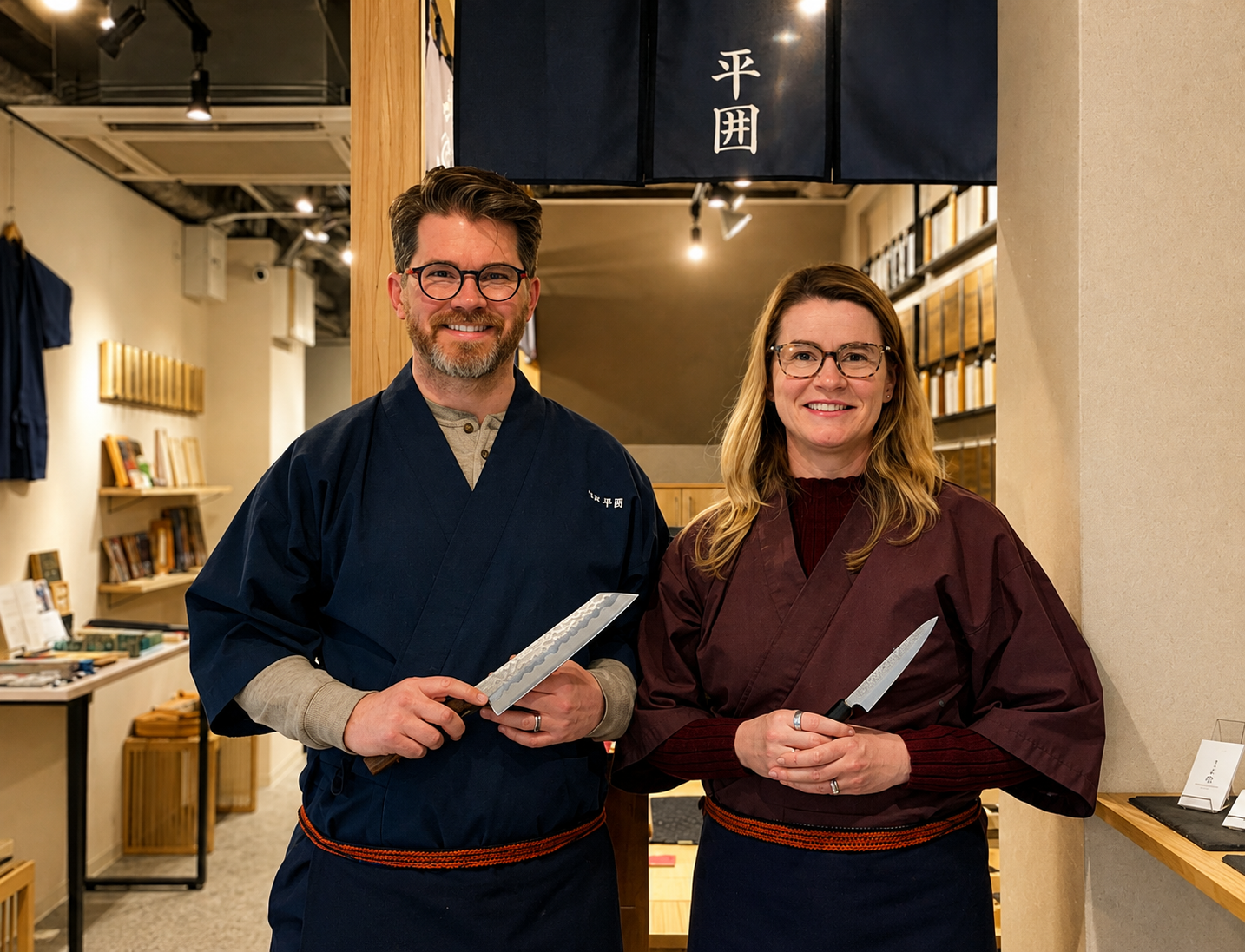
- Japanese working uniform and apron
- Experience fee
- Engraving fee
How the Hirai Workshop Runs
One to two hours, up to three guests.
Choose Your Blade
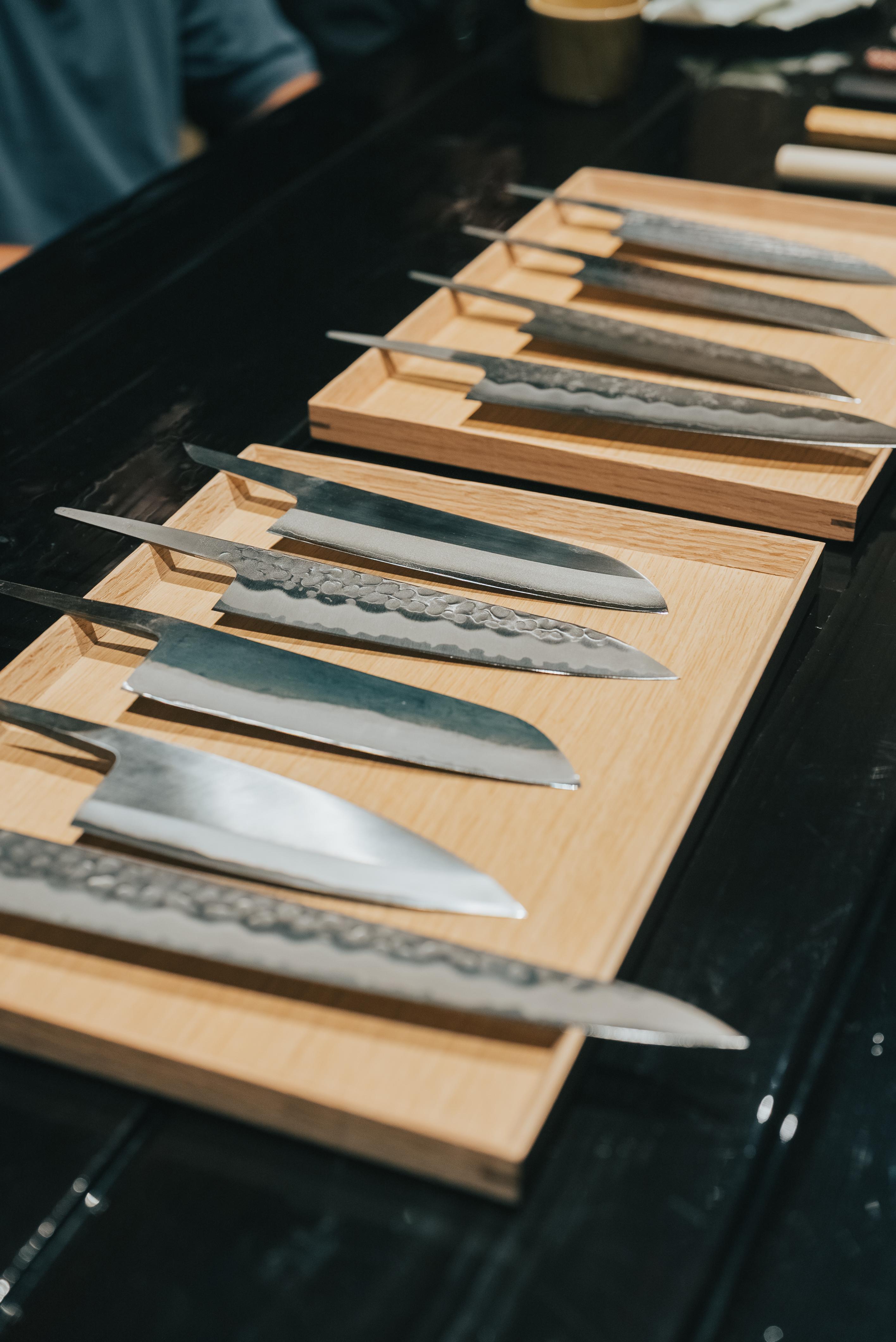
Pick a santoku, deba or yanagiba for the workshop. Other blades and handle woods are available at extra cost.
Learn to Sharpen
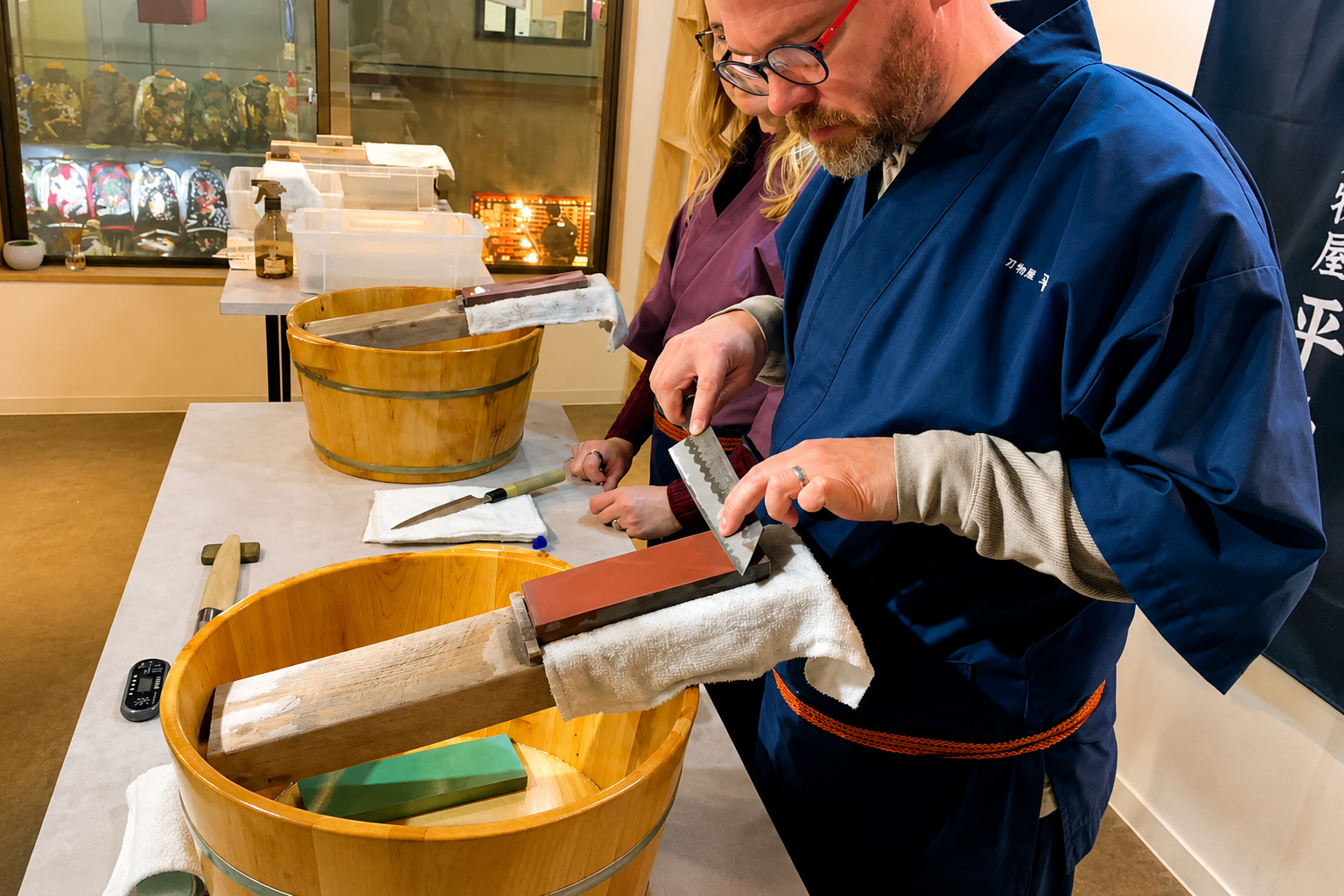
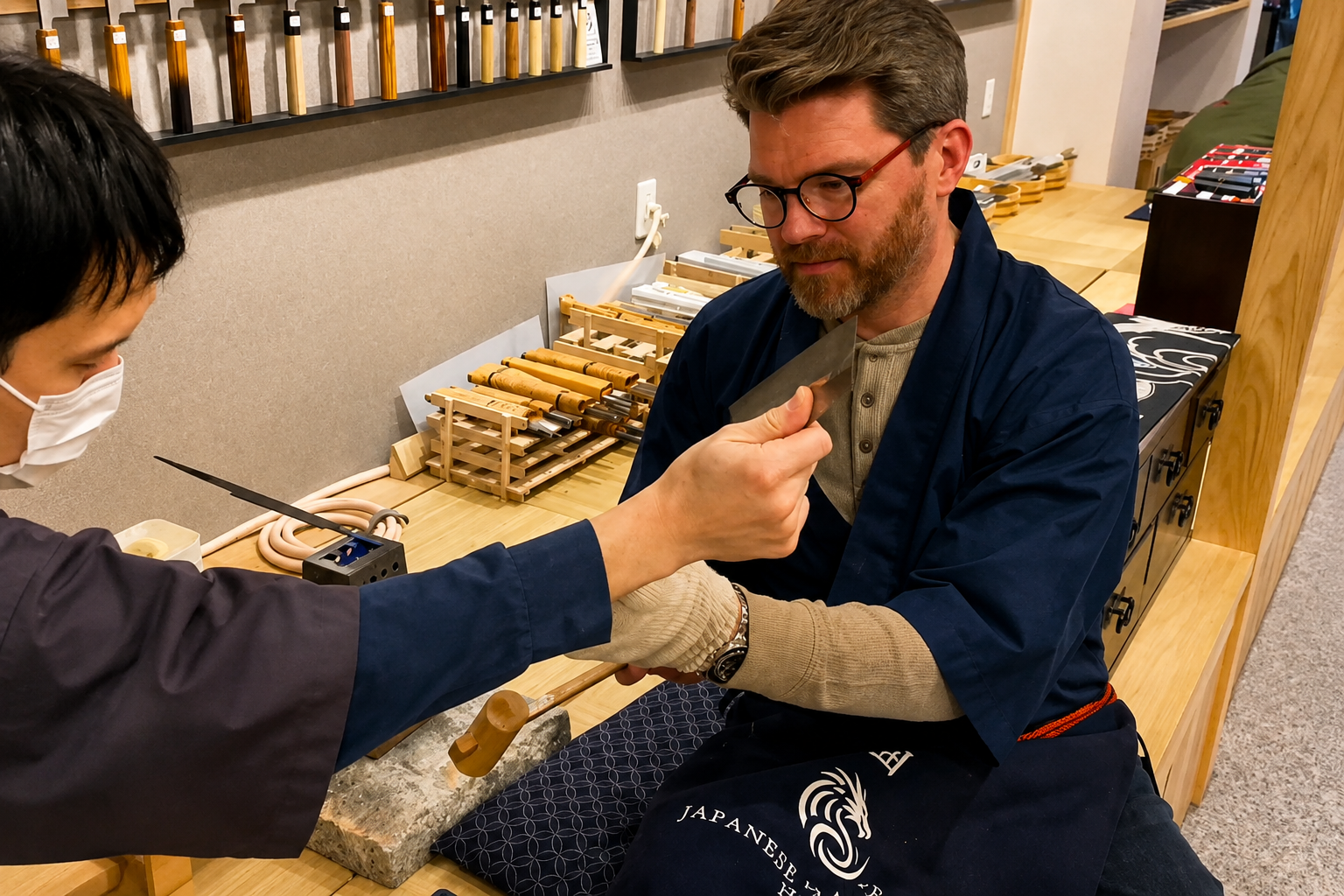
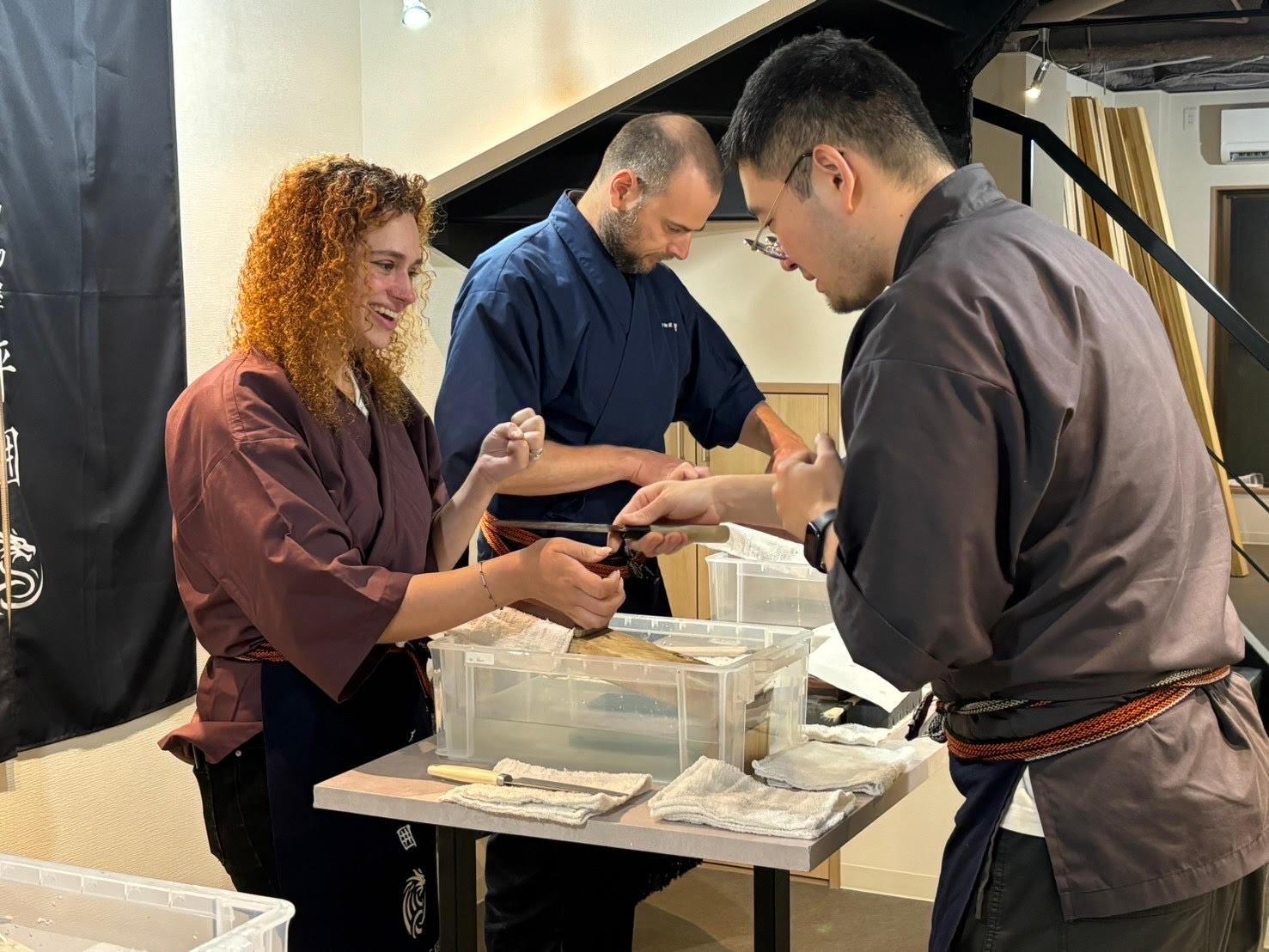
Learn the angle and pressure on the shop's whetstones, then sharpen your own knife with the instructor checking your edge.
Fit the Handle
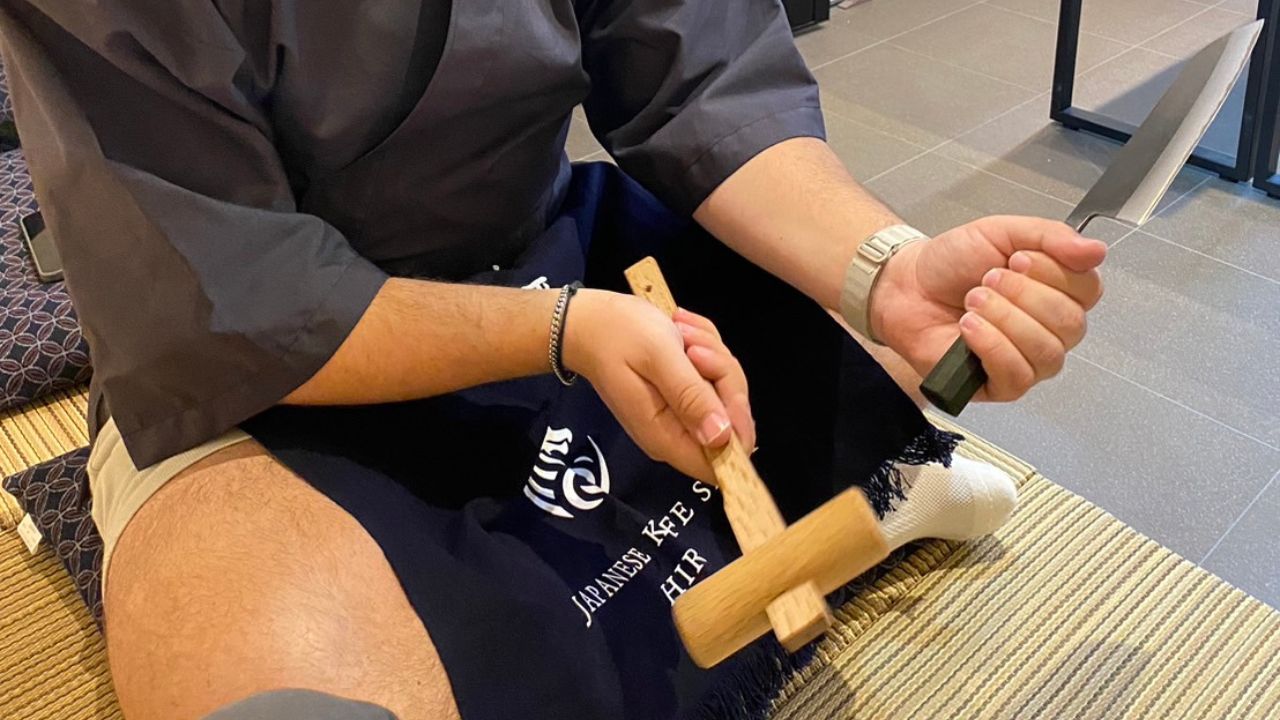
Fit a magnolia handle using heat and a mallet. There is some smoke, so wear clothes you do not mind smelling of it.
Engrave and Take It Home
Engraving is listed as included; tell the shop in advance if you want it. The knife leaves with you.
Photo Gallery
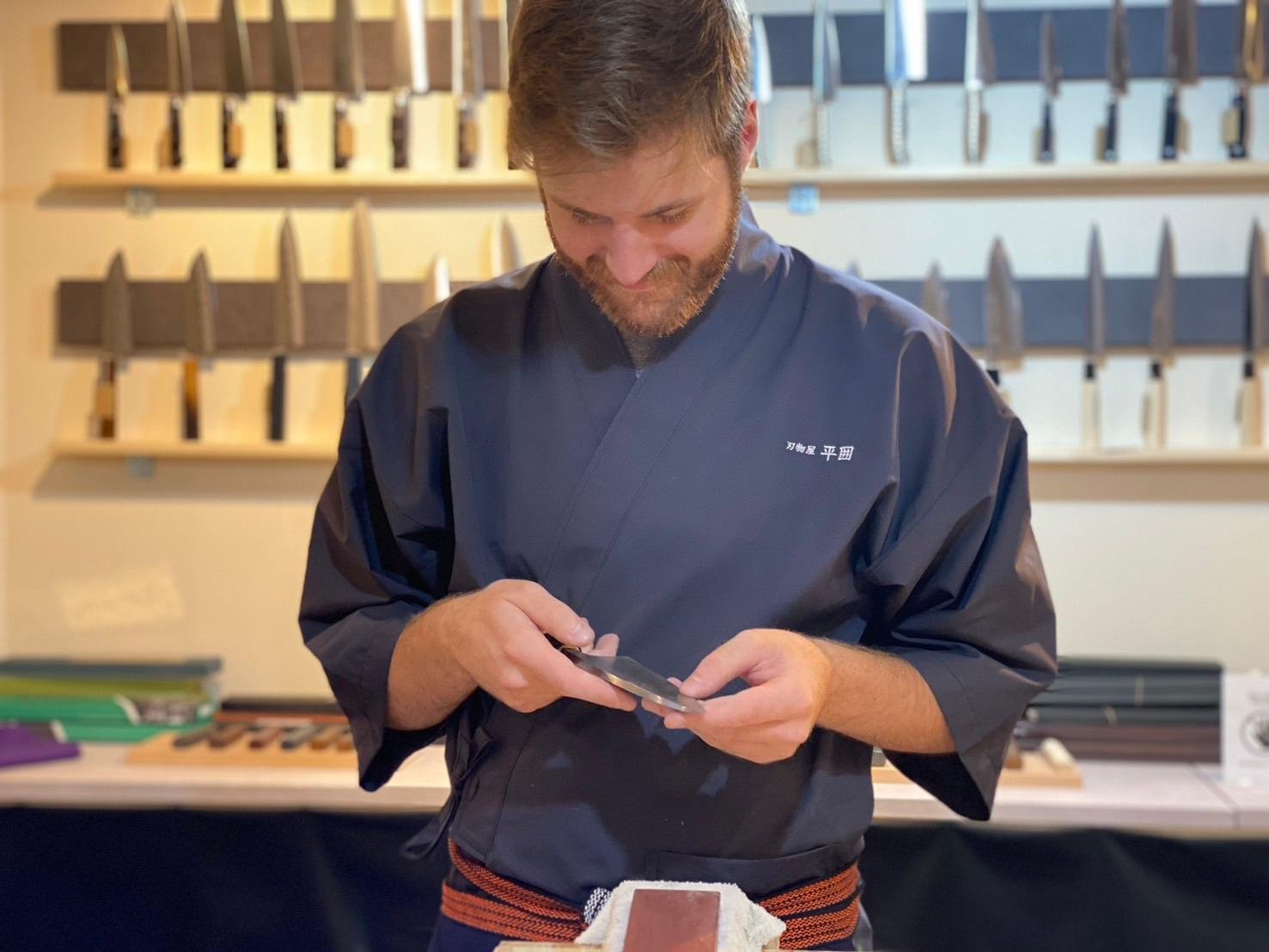
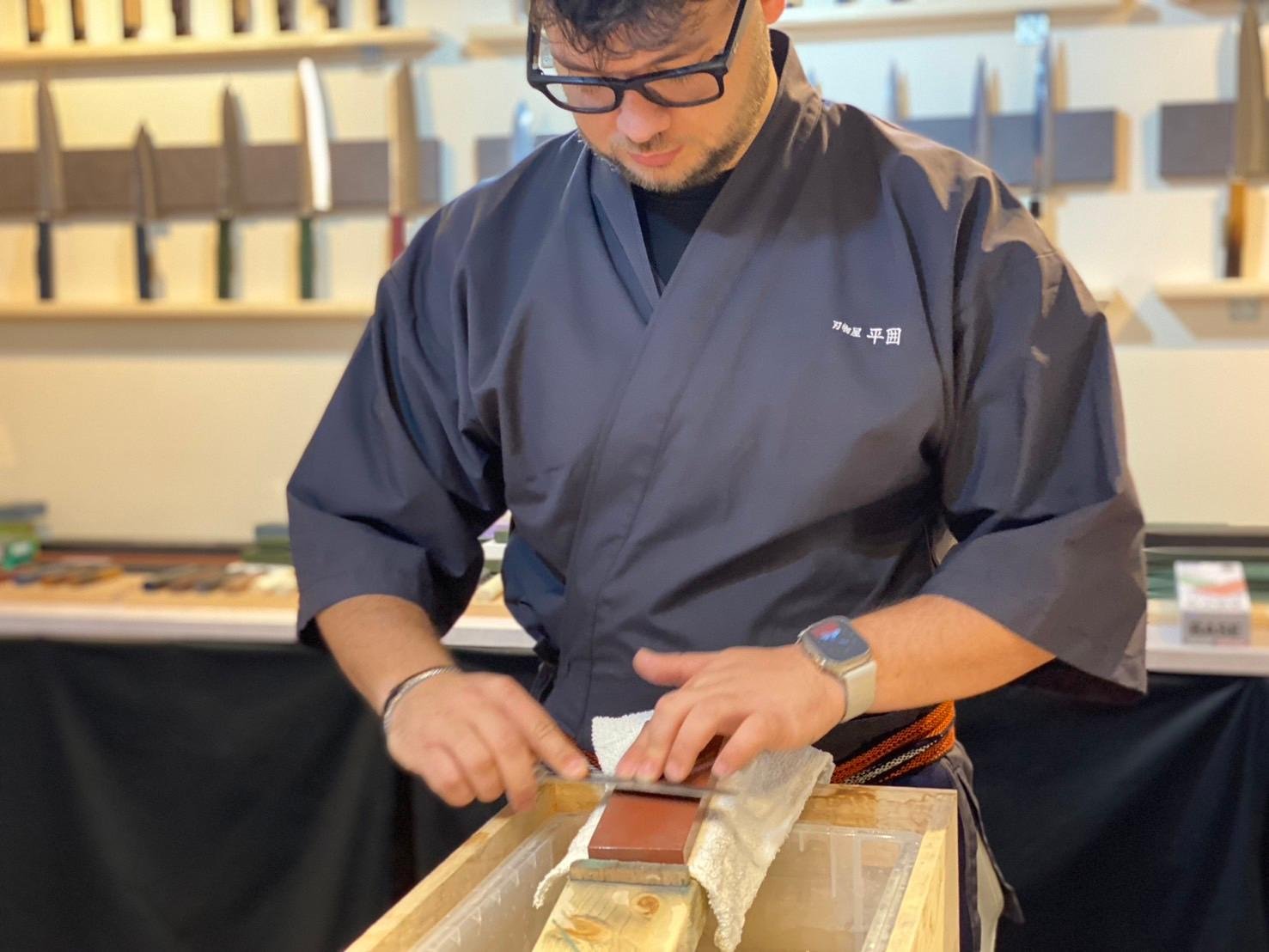
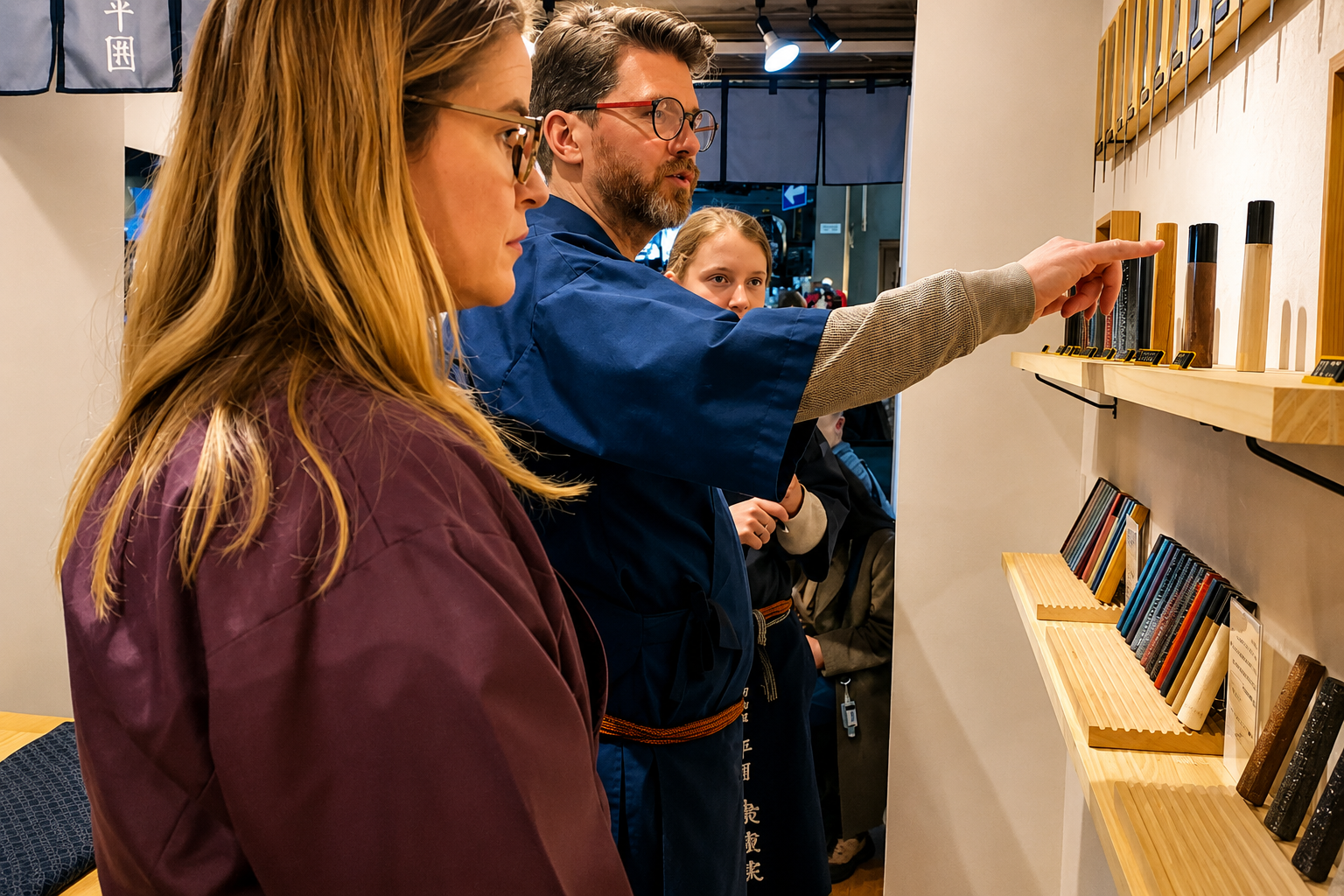
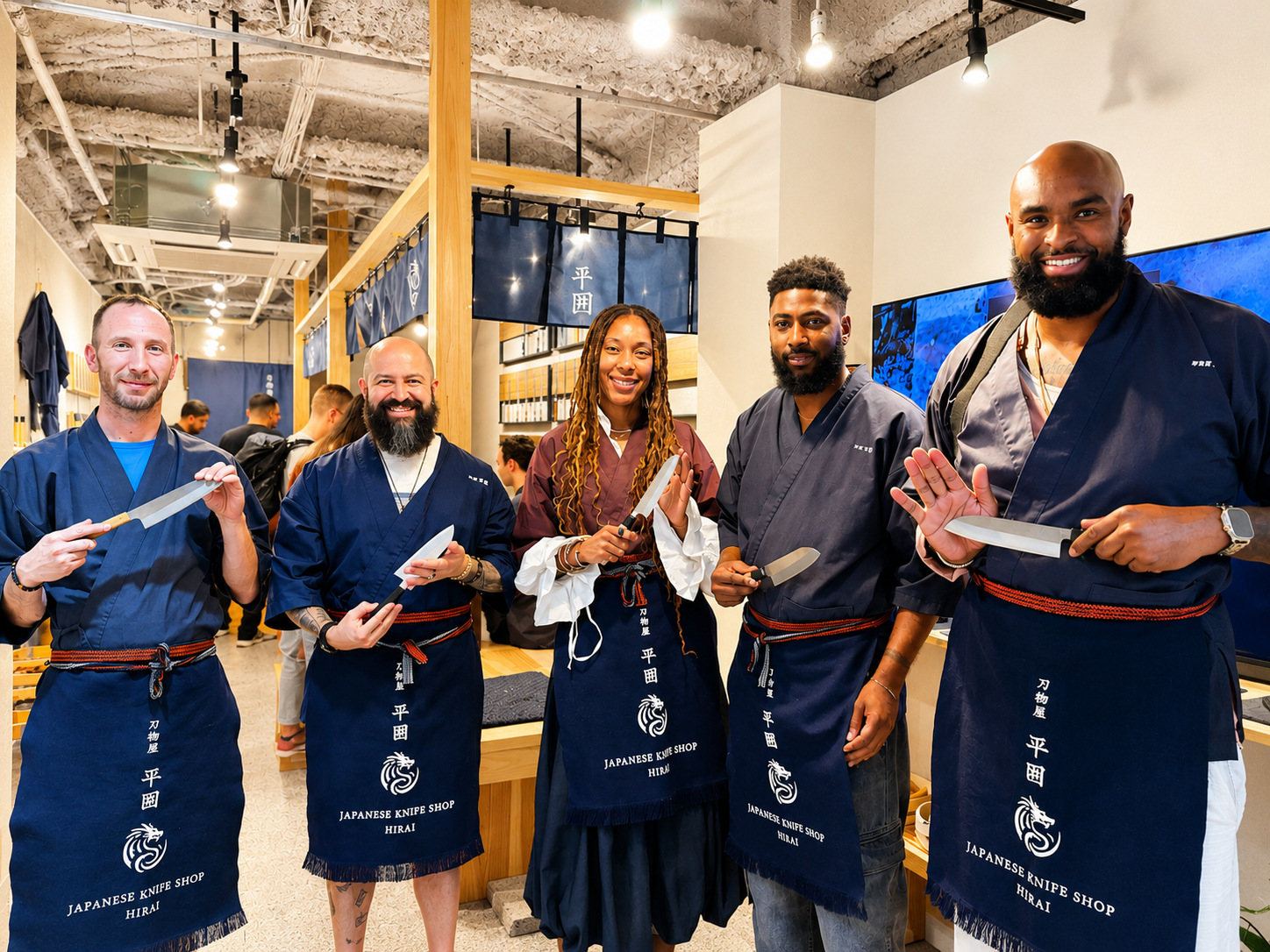
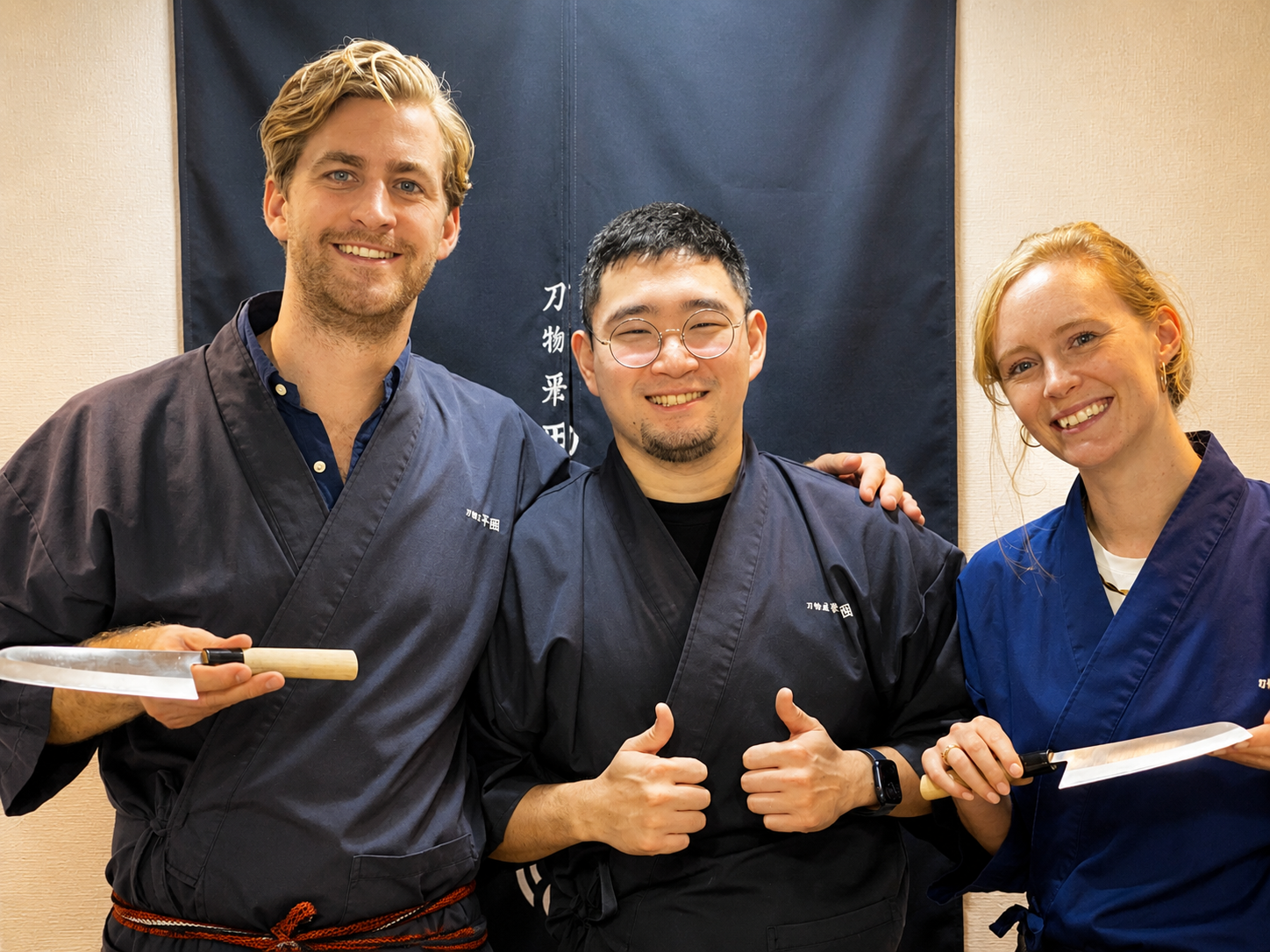
Inside the Hirai Knife Shop
Whetstones, blades waiting for handles, and the knives guests take home.
Book Your Experience
Check Availability & Prices
Pick a date on the calendar. Cancel up to 24 hours in advance for a full refund.
Buy One, Sharpen One or Forge One?
Three ways to leave Kyoto with a Japanese knife. Prices checked in October 2026.
| Feature | IN A KNIFE SHOP Sharpen & Fit Your Own (Hirai) | Forge One (Kendo Experience) | Buy a Finished Knife |
|---|---|---|---|
| Starting Price | From $32/per person | From $151 (Oct 2026) | From about ¥8,000 to ¥10,000 |
| Time | 1 to 2 hours | 3 hours | As long as you like |
| What you leave with | A santoku, deba or yanagiba you sharpened and fitted | A small knife you forged from iron | Any knife on the shelf; Aritsugu puts the final edge on for you |
| Choice of knife | Three blades; other handles cost extra | Shape chosen before forging | The whole range, ¥8,000 to ¥80,000 |
| Skill you take home | Whetstone sharpening | Forging basics | None, but the shop can advise on care |
| Where | Teramachi, by Nishiki Market | Sakyo-ku, north-east Kyoto | Nishiki Market, Teramachi, Shijo-dori |
| Best for | Cooks who want a knife and the skill to keep it sharp | A forging afternoon more than a kitchen knife | Knowing exactly which knife you want |
| Check Workshop Dates | Compare Forging |
Other Ways to Leave With a Knife You Made
Forge one from a piece of iron in Sakyo-ku, or sharpen one in Arashiyama. Prices checked in October 2026.
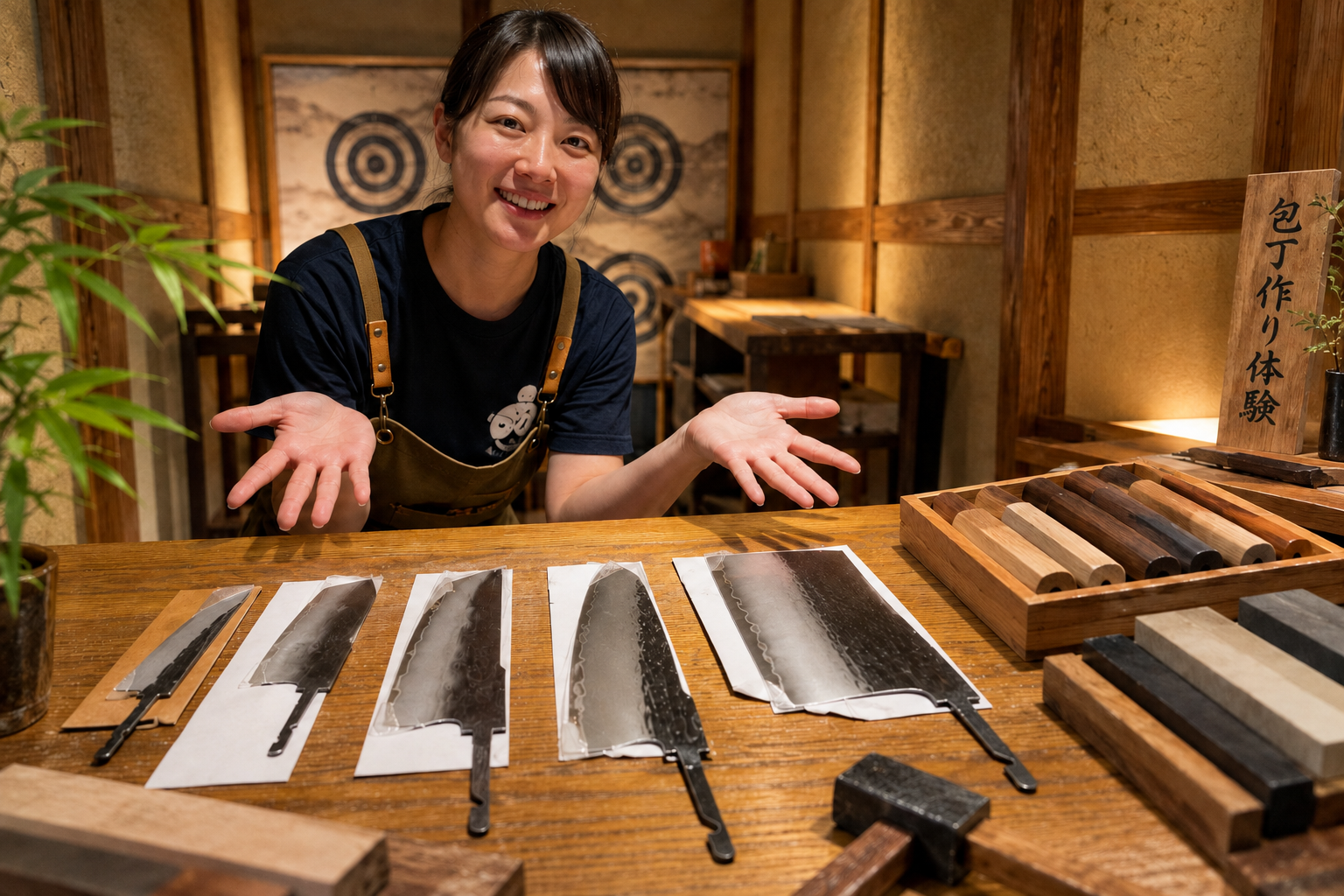
 FORGE ONE FROM IRON
Authentic knife making experience at a blacksmith in Kyoto
Through this experience, you will learn about “forging” in depth. You will learn how to use the tools and make a knife using the same traditional process as Japanese kitchen knives.
 BUDGET · ARASHIYAMA
Kyoto: Craft or Sharpen Your Own Japanese Kitchen Knife
About an hour in Arashiyama. The beginner plan sharpens a knife with its handle already on; the custom plan adds a choice of blade and fitting the handle yourself.
Shopping for a Knife in Kyoto
Kyoto's Knife Shops, One Block at a Time
Seven shops worth the walk, what to buy first, what it costs, and the 2026 tax-free change.
Buy your knife at Aritsugu if you want Kyoto’s famous name and do not mind a crowd; buy it at one of the shops a few doors away if you want room to compare. Kyoto’s knife shops are packed into a few blocks around Nishiki Market, the Teramachi covered arcade and Shijo-dori, so you can see five of them in an hour. Aritsugu closes on Wednesdays. Plan around that, and leave with yen in your pocket and a box in your bag.
The shops, from Nishiki Market outwards
Aritsugu is on the north side of Nishiki Market, a short walk west of the Teramachi arcade, about eight minutes on foot from Kyoto-kawaramachi Station on the Hankyu line. Guides date it to 1560, and the shop’s own site speaks of a 450-year history. It is usually full of chefs and cooking enthusiasts. Kitchen knives start at around ¥10,000. Staff finish your knife on a large revolving whetstone at the counter. The shop’s own site gives hours of 10:00 to 17:00, with new sales taken until 16:30, and closing days of Wednesdays, 1 to 4 January and 31 January for stocktaking (checked November 2026); other guides print different hours, so go by the shop’s. Name engraving, which the shop once did on request, has ended: its website says it is no longer offered, so do not plan on a name on the blade here. One guide says it takes cash only, so carry yen to be safe.
Yoshimune is a small basement shop at the eastern end of Nishiki Market. It stocks knives from across Japan for every budget, and placards on each one show where it was made, the blade type and the steel. That makes it the easiest shop in the city for comparing like with like.
Jikko, a cutlery maker from Sakai, opened its Kyoto shop in January 2024 at the corner where Nishiki Market meets Teramachi: more than a hundred knives in the ground-floor showroom and a “knife tower” of 180 mirror-polished blades upstairs. It is the polished, upscale end of the street. Seisuke is down the street, with its own-brand knives on the walls and staff who are happy to answer questions.
Hirai sits on the Teramachi shopping street, a few minutes from Nishiki Market. The owner, Tatsunari Hirai, trained with a knife maker in Sakai, and the shop sells Sakai-made blades. You choose a blade and a handle and the shop assembles them while you wait, or you join the workshop below and do the sharpening and handle fitting yourself.
Musashi Japan opened on Shijo-dori, just east of Teramachi, in March 2025. It is modern and bright, lets you handle the knives, has staff who speak several languages and is open from 11:00 to 21:00, which makes it the one to try after the older shops have closed.
Shigeharu is described by a 2026 guide as Kyoto’s oldest knife shop: a one-man business where the owner forges the blades himself, with irregular opening hours. Treat it as a bonus if you find it open.
What to buy first
If you are buying one knife, buy a gyuto or a santoku. The gyuto is the longer, pointed all-rounder, close to a Western chef’s knife; the santoku is shorter and flatter, easy to control and good for vegetables. Both are double-bevel, sharpened on both sides, which is what everyday cooking wants. The single-bevel knives in the windows, the long yanagiba for slicing raw fish and the heavy deba for breaking down fish, are specialist tools. Inside Kyoto suggests a specialist knife at Aritsugu, because that is what the shop is known for; a home cook is usually better served by one good all-rounder.
Steel is the second choice. Carbon steel takes a very fine edge and rusts if you leave it wet; stainless is easier to live with. Ask the shop which it is and how to care for it before you pay.
What it costs
A 2026 guide to these shops puts the range at about ¥8,000 to ¥80,000, with ¥20,000 to ¥30,000 (roughly $130 to $190) buying a high-quality everyday knife. Aritsugu’s kitchen knives start at around ¥10,000. Most shops offer tax-free sales to visitors, and from 1 November 2026 that works as a refund: you pay the full price, spend at least ¥5,000 before tax in one shop on one day, and claim the tax back as you leave Japan, at a customs terminal or through Visit Japan Web in the departure lobby before check-in. Do the customs step before the bag with the knife goes on the belt.
Or sharpen your own at the Hirai shop
If you would rather leave with a knife you worked on, the Hirai shop’s workshop is the shopping trip and the lesson in one. You choose a santoku, deba or yanagiba, learn to sharpen it on the shop’s whetstones, fit a magnolia handle using heat and take it home, in one to two hours with up to two other guests. It is rated 4.9 from 175 reviews, from about $32 as of October 2026 for the basic option, and runs in English and Japanese. Under-12s cannot join.
Reviewers mostly come for the sharpening: one was “scared of sharpening my own knives” and left with the confidence to do it at home. If you want the fire and the anvil instead, the forging class in Sakyo-ku is the one class in Kyoto that makes a knife from iron; our Kyoto knife making guide compares it with every sharpening workshop in the city.
You want the knife and the skill
Sharpen and fit your own at Hirai
A santoku, deba or yanagiba, sharpened by you in a working knife shop, 1 to 2 hours.
Check workshop datesYou want the fire
Forge a small knife from iron
Three hours at a forge in Sakyo-ku, ages 15 and up. A keepsake first, a kitchen knife second.
See the forging classPrices, ratings and review counts from our October 2026 data check; operators change prices, so treat them as the shape of the market, not a quote.
Getting it home
Keep the knife in its box, wrapped, and take it straight back to your hotel. Japan’s Swords and Firearms Control Law bars carrying a blade over 6 cm without a legitimate reason; taking a purchase home is one, wandering the city with it for the afternoon is not, so shop last. On the flight it goes in checked luggage only, sheathed or securely wrapped as the TSA asks. Ask the shop to pack it for travel when you pay.
Guest Reviews
What Visitors Say
4.9/5
from 175 verified visitors
"It was a great event. The staff and guides there take a lot of time to explain everything and share their knowledge. We had a lot of fun, and our knives are great 😍"
"I was scared of sharpening my own knives because of hearing how easy it is to mess up the knife. The workshop made it very straight forward and has given me the confidence to sharpen my own knives at home."
"It was a great experience to learn how to properly sharpen the knife. I picked the Deba knife and got it with personalised engraving. I would recommend this if you’re interested in cooking and Japanese knives. I found the cost very reasonable considering you’re getting a knife to take home."
"Julio was super helpful during the workshop. We learned all the techniques for sharping our knives at home. Also to be able to take home a knife we sharpened and fitted handles. The workshop was very easy to follow, and was easy to follow. It was a small group so Julio had plenty of time of help. Would definitely recommend this workshop and it was only 2 hours. So easy to fit into your day."
"C'était vraiment très précis et utile. on recommande vivement cette activité. Svetlana et Roland"
"Julio gave clear instructions and helped me feel confident in sharpening my professional knives. I am so pleased with my new DEBA Knife and even had the blade engraved. The workshop was well-organized. The space was tight, but the staff made it work."
"My husband Bob really enjoyed this knife sharpening and is very happy to bring his knife home to Perth."
Read all 175 verified reviews
See All ReviewsReady to Book Your Kyoto Experience?
Pick the right category for your trip — tea ceremony, geisha experience, sumo show, Fushimi Inari, day trip, or private tour. 119 tours compared with free cancellation. Starting from $32 per person.
Browse All Kyoto ToursBuying a Knife in Kyoto: Questions People Ask
Which shop, what to buy, what it costs, tax-free and flying home with it.
Aritsugu on Nishiki Market is the most famous: it traces its history to 1560, is usually full of chefs and cooking enthusiasts, and puts the final edge on your knife at the counter. It is not the only good choice. Hirai on Teramachi sells Sakai-made knives and runs a sharpening workshop, Jikko and Seisuke have large displays a few doors from each other, and Musashi on Shijo-dori stays open until 21:00. The best shop is the one with the knife you want at a price you are happy with, and they are all within about ten minutes' walk.
In and around Nishiki Market. Aritsugu is on the north side of the market, a short walk west of the Teramachi arcade; Yoshimune is in a basement at the market's eastern end; Jikko's shop stands where the market meets Teramachi, with Seisuke down the street; Hirai is on the Teramachi shopping street; Musashi is on Shijo-dori just east of Teramachi. Kyoto-kawaramachi Station on the Hankyu line is about eight minutes' walk from Aritsugu, by the shop's own figure.
Either works; the difference is scale. Tokyo has Kappabashi Dougu Street between Ueno and Asakusa, a whole street of kitchenware and knife shops, many of which close on Sundays. Kyoto's knife shops are fewer but packed into a few blocks around Nishiki Market, so you can compare five shops in an hour. If Kyoto is on your trip anyway, buy here; Aritsugu closes on Wednesdays, so plan around that.
Usually, and the choice is far wider than at home. Visitors can also reclaim consumption tax at shops that offer tax-free sales. From 1 November 2026 that works as a refund: you pay the full price in the shop, spend at least 5,000 yen before tax in one shop on one day, and claim the tax back when you leave Japan, at a customs terminal or through Visit Japan Web in the departure lobby before check-in. Do that step before the bag with the knife goes on the belt.
They have a strong reputation in Japan and the shop is busy with professional cooks. The staff finish every knife on a large revolving whetstone before you take it. If you choose carbon steel, it takes a fine edge but rusts if you leave it wet, so ask about care before you pay. Kitchen knives start at around 10,000 yen.
The shop's own site gives 10:00 to 17:00, with new sales taken until 16:30 (checked November 2026). It closes on Wednesdays, from 1 to 4 January and on 31 January for stocktaking. Other guides print different hours, so go by the shop's. Go in the morning, before the market crowds build, and check the shop's site before you cross town.
No longer, by the shop's own account. Aritsugu used to engrave names on request, and some older guides still describe it, but the shop's website now says the name engraving it once accepted has ended and is not offered (checked November 2026). Do not plan on a name on the blade; ask at the counter if you want to be sure.
Yes, and only there: knives are not allowed in carry-on bags. The TSA asks that any blade in a checked bag is sheathed or securely wrapped, so ask the shop to pack it for travel. In Japan, keep the knife boxed and wrapped and take it straight back to your hotel; carrying a blade over 6 cm without a legitimate reason is an offence under the Swords and Firearms Control Law, and taking a purchase home is the legitimate reason.
In Kyoto's shops you will see knives from about 8,000 yen to 80,000 yen. A 2026 guide to the city's knife shops puts 20,000 to 30,000 yen (roughly $130 to $190) as a good range for a high-quality knife, and Aritsugu's kitchen knives start at around 10,000 yen.
Either is the right first knife. The gyuto is longer and pointed, closer to a Western chef's knife, and suits rocking cuts and meat. The santoku is shorter with a flatter edge, easy to control and good for vegetables in a small kitchen. Both are double-bevel, which is what you want for everyday cooking. Single-bevel knives such as the yanagiba and deba are specialist tools for fish.
In Kyoto, $100 is about 15,000 yen, which buys a solid everyday santoku or gyuto at most of the shops around Nishiki Market, including entry models at Aritsugu. Pick the shape first and the steel second: stainless is easier to live with, carbon steel sharper but needs drying after every use. Ask the shop how to sharpen and store it before you leave.
Ask where it was made and what steel it is; good shops label both, and Yoshimune's placards show the origin, blade type and steel for each knife. Hold it: the handle should sit flush to the blade with no gaps, and the balance should feel right in your hand. Then ask whether the shop will sharpen it before you leave. A knife from a known knife town with a clear steel type and a fitted handle is a safe buy.
Yes, if you will cook with it. You get a far wider choice of shapes and steels than most countries sell, and shops that will sharpen the blade for you. If you want the story as well as the knife, the sharpening workshop at Hirai or the forging class in Sakyo-ku sends you home with a knife you worked on yourself.
Still have questions? Email us at info@thingstobookinkyoto.com